
Lessons from a pioneering Dutch community and what they could mean for families in Southern New Jersey
By Reva Farenback-Brateman, MSW, CDP, JFCS Geriatric Case Manager & Community Educator
For many families, a dementia diagnosis brings understandable fear. Questions about safety, independence, quality of life, and long-term care often arise immediately. Too often, the conversation centers on what has been lost.
But during a recent professional training mission to The Hogeweyk, an internationally recognized dementia village in the Netherlands, I was challenged to think differently. The experience reinforced an important question that is becoming increasingly relevant as our population ages: What if dementia care focused not only on keeping people safe, but also on helping them continue to live meaningful, purposeful lives?
This summer, Jewish Family & Children’s Service (JFCS) of Southern New Jersey provided me with the opportunity to participate in an international learning program through the Textus Mentis Foundation and the Network of Jewish Human Service Agencies. Alongside professionals from the United States, Canada, Europe, Australia, and South America, I spent several days learning about innovative approaches to dementia care at The Hogeweyk, located just outside Amsterdam.
While the setting itself was remarkable, the most valuable lessons were not about architecture or geography. They were about dignity, choice, connection, and what it means to support older adults as whole human beings.
A Different Way of Thinking
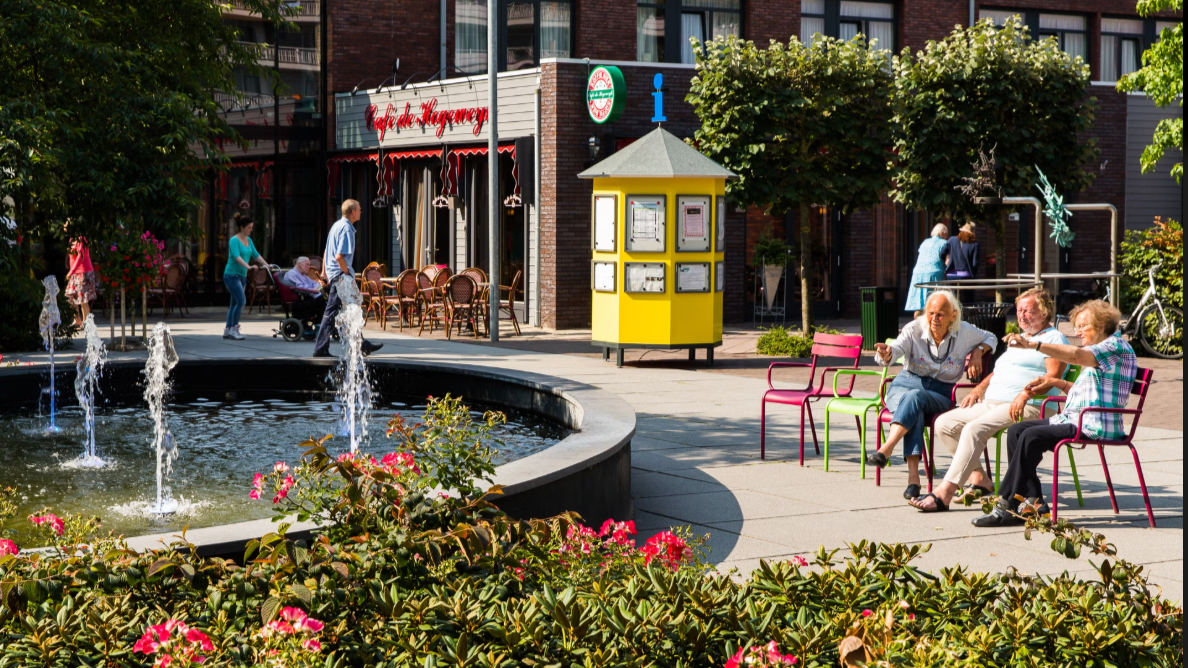
Opened in 2009, The Hogeweyk is home to nearly 200 people living with advanced dementia. Unlike a traditional nursing home, it is designed as a neighborhood, complete with walking paths, gardens, a grocery store, restaurant, theater, salon, and gathering spaces.
What makes it extraordinary, however, is not the physical environment. It is the philosophy. The central belief is simple: a person living with dementia is still a person.
Rather than focusing primarily on limitations, staff focus on strengths. Rather than centering care around tasks and routines, they center care around individual preferences, relationships, interests, and abilities. Residents are encouraged to make choices, participate in daily life, pursue hobbies, and contribute to their community whenever possible.
Their guiding principle can be summed up in one powerful idea: focus on what people can do, not what they can no longer do.
The Importance of Purpose
One of the most meaningful takeaways for me was the emphasis placed on purpose.
As professionals and caregivers, we can become so focused on completing tasks that we unintentionally take opportunities away from the people we are trying to help. We dress them more quickly. We prepare meals instead of inviting participation. We make decisions on their behalf instead of offering choices.
Yet every time we do something for someone that they could still do themselves, we risk taking away a piece of their independence.
The Hogeweyk embraces a philosophy often summarized by the phrase, “Everything you do for me, you take from me.” That statement is not meant to discourage helping. Rather, it reminds us that dignity is often found in everyday acts such as choosing what to wear, setting the table, watering plants, helping prepare a meal, or deciding how to spend the afternoon.
Purpose matters at every stage of life. Dementia does not change that. People continue to need opportunities to contribute, connect with others, and feel that they matter.
When older adults remain engaged in meaningful activities, they are often calmer, more confident, and more connected to the world around them. Rather than viewing activities as something to fill time, The Hogeweyk views them as essential to well-being.
Rethinking Risk
Perhaps the most thought-provoking aspect of the experience was the Dutch approach to risk.
In American aging services, safety often drives decision-making. Families and organizations understandably want to prevent falls, injuries, wandering, and medical complications. At The Hogeweyk, safety remains important, but it is balanced against another value: freedom.
Walking outside carries some risk. Cooking carries some risk. Participating in community activities carries some risk. But those same activities also create joy, confidence, social connection, and a sense of purpose.
The Dutch approach asks a difficult question: Are we helping people live, or simply helping them avoid harm?
There are no easy answers. Regulations, resources, and cultural expectations differ greatly between countries. Yet the conversation itself is valuable. It challenges us to think about how we can preserve autonomy while still providing appropriate support.
For families, this can mean looking for opportunities to say “yes” when possible. It can mean allowing a loved one to continue participating in familiar routines, hobbies, or household tasks, even if they need some assistance. The goal is not to eliminate all risk, but to maximize quality of life.
What This Means for Families
Families caring for loved ones with dementia often struggle with uncertainty, stress, and guilt. They worry constantly about making the right decisions.
One lesson that emerged repeatedly during the training is that quality of life matters just as much as quality of care. Meaningful activities are not luxuries. Social engagement is not optional. Opportunities for choice are not insignificant. These elements are essential to well-being.
Whether someone is living independently, with family, attending an adult day program, or residing in a care facility, we should continually ask: What brings this person joy? What gives them a sense of purpose? What choices can they still make? How can we build on remaining strengths rather than focusing solely on losses?
These questions can help create more positive experiences for both individuals living with dementia and those who care for them.
What This Means for Southern New Jersey
The experience also sparked important conversations about the future of dementia support in our community.
While creating a dementia village in South Jersey may not be realistic, the principles behind The Hogeweyk are highly relevant to the work we do every day at JFCS. Programs such as Café Connection already incorporate many person-centered practices, including social engagement, meaningful activities, and opportunities for participants to connect with others facing similar challenges.
The training reinforced the importance of continuing to expand these approaches and finding new ways to support both people living with dementia and their care partners. It also highlighted the value of Montessori-inspired dementia care techniques, which emphasize engagement, choice, strengths, and preserving abilities whenever possible.
These concepts can be woven into support groups, caregiver education, social programs, and everyday interactions. Small changes, such as offering more choices, encouraging participation in meaningful tasks, and focusing on abilities rather than limitations, can have a significant impact on a person’s sense of dignity and well-being.
Most importantly, the experience challenged me to continue asking a fundamental question: Who are we doing this for?
When that question remains at the center of our work, it becomes easier to create services that honor dignity, foster independence, and promote meaningful living.
Looking Ahead
Dementia remains one of the greatest challenges facing older adults and their families. Yet The Hogeweyk demonstrates that a diagnosis does not have to mean the end of purpose, connection, or joy.
As our community continues to age, we have an opportunity to rethink how we support people living with dementia. By focusing on strengths, preserving choice, encouraging engagement, and respecting individuality, we can help ensure that people are not simply living longer, but living well.
At JFCS, that is a conversation we are committed to continuing.
